
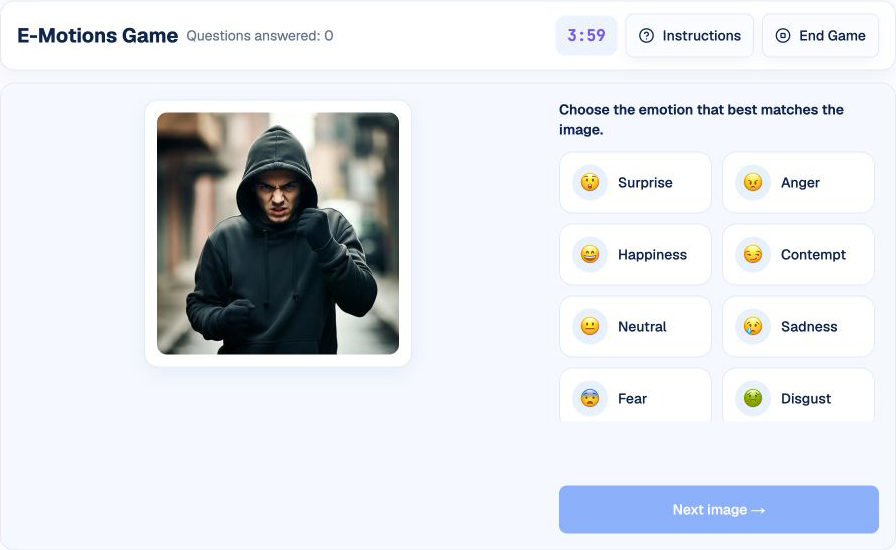
E-Motions asks you to translate a facial expression into an emotion label. Familiar expressions may be quick to recognize, while subtle differences—such as fear versus surprise or anger versus contempt—require a more deliberate comparison.
This guide follows HireVueGames' independent E-Motions practice. Familiarity cannot guarantee an employer outcome, but it can help you learn the response labels and develop a consistent way to inspect facial cues under a timer.
What Is the HireVue E-Motions Game?
E-Motions is a timed emotion-recognition task. A photograph appears alongside several possible emotions. Choose the label that best matches the visible expression, then select Next to record the response and continue.
The independent practice uses eight labels: Surprise, Anger, Happiness, Contempt, Neutral, Sadness, Fear, and Disgust. Other assessment versions may use different images, labels, timing, context, or scoring.
What Skills Does E-Motions Practice?
- Emotion recognition: mapping facial cues to emotion categories.
- Observation: noticing changes around the eyes, eyebrows, mouth, nose, and jaw.
- Visual comparison: distinguishing expressions that share some features.
- Decision speed: choosing a label without becoming stuck on one image.
- Attention consistency: applying the same observation method across many faces.
These are general task demands, not confirmed official employer scoring dimensions.
How the E-Motions Game Works
The independent round lasts four minutes. One photograph appears with eight emotion options. Select a label, then choose Next. The practice records the response and loads another randomized image.
The task evaluates how accurately you identify the displayed emotion while working through as many images as possible within the time limit. Feedback and score presentation can vary by assessment version.
1. View the Whole Expression
Take in the overall facial tension and emotional intensity before focusing on individual features.
2. Check Key Regions
Compare the eyes and eyebrows, then the mouth, nose, and jaw. Look for a combination of cues rather than relying on one feature.
3. Compare the Closest Labels
If two emotions seem plausible, identify the feature that best separates them.
4. Select and Continue
Once one label is better supported, choose it and move on. The overall timer continues.
A Repeatable E-Motions Strategy
Start With Emotional Valence and Intensity
Ask whether the expression appears positive, negative, or neutral, then whether it is high-energy or subdued. This narrows the label set.
Read Eyes and Mouth Together
A smile without corresponding eye movement may communicate something different from broad happiness. Treat the face as a combined signal.
Separate Similar Emotions
- Fear versus surprise: both may show wide eyes, but fear often adds tension.
- Anger versus disgust: anger often emphasizes brow and jaw tension; disgust often involves the nose and upper lip.
- Contempt versus happiness: contempt may appear asymmetrical rather than as a full smile.
- Sadness versus neutral: sadness often includes changes around the inner eyebrows and mouth.
These are observation prompts, not infallible rules. Facial expressions vary across people and contexts.
Use Context Carefully
Visible context can help, but do not invent a story that overrides the expression shown.
Keep Moving
When evidence is genuinely ambiguous, choose the best-supported label and continue rather than spending a disproportionate share of the round on one image.
Common E-Motions Mistakes
- Looking only at the mouth: misses information in the eyes and eyebrows.
- Using one cue as proof: many emotions share individual facial movements.
- Ignoring asymmetry and tension: loses useful distinctions between similar labels.
- Overinterpreting context: substitutes a guessed story for visible evidence.
- Treating a label as universal: expressions vary, so use the full face and available options.
A Practical E-Motions Training Routine
Round 1: Learn the Label Set
Understand the eight available emotions and identify the main cues you associate with each.
Round 2: Use a Fixed Facial Scan
Check whole face, eyes and brows, then mouth and jaw on every image.
Round 3: Improve Close Comparisons
Focus on the label pairs that create the most hesitation and name the deciding cue.
Understanding Your E-Motions Practice Results
Review emotion-recognition accuracy together with response pace. Repeated confusion between the same label pair suggests a useful area for focused practice, while fast responses with falling accuracy indicate rushed observation.
Practice results can help track familiarity and recurring mistakes, but they do not reproduce an employer's proprietary EQ model or predict a hiring decision.
Practice the E-Motions Format
Use E-Motions practice to apply the whole-face, key-region, closest-label routine.
Related people-focused formats include the Teamchat guide, Portrait guide, and PortraitXT guide.
Disclaimer: HireVueGames is an independent preparation platform and is not affiliated with, endorsed by, or operated by HireVue. This guide describes independent practice and does not reproduce HireVue's proprietary questions, emotion model, scoring system, or employer evaluation process. It is not an official HireVue assessment, exact replica, or score prediction tool.
Related Guides
Teamchat Guide
Read workplace context and choose constructive responses.
Read GuidePortrait Guide
Understand the picture-based work-style preference format.
Read GuidePortraitXT Guide
Approach statement ratings consistently and authentically.
Read Guide