
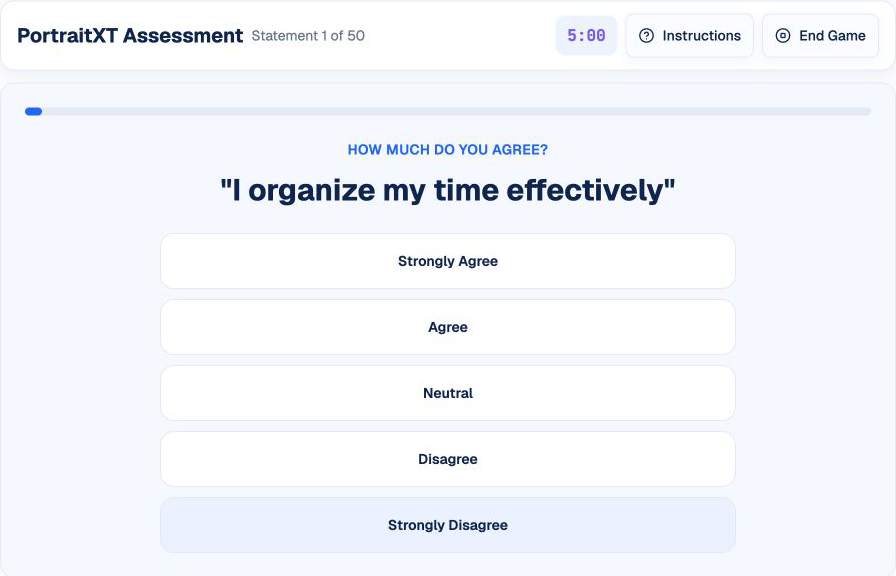
PortraitXT replaces pictures with statements. Instead of solving a problem, you decide how strongly each statement describes your usual work preferences and behavior.
This guide follows HireVueGames' independent PortraitXT practice. Rehearsal cannot reveal an employer's scoring model, but it can make the five-point response scale familiar and help you answer with less avoidable hesitation.
What Is the HireVue PortraitXT Game?
PortraitXT is a statement-based personality and work-style assessment. A statement such as “I am an ambitious person” appears, and you choose a response from Strongly Agree to Strongly Disagree.
The independent practice presents up to 50 randomized statements in five minutes. Other assessment versions may use different statements, timing, length, scales, or scoring logic.
What Does PortraitXT Explore?
- Self-assessment: how you describe your own tendencies.
- Personality traits: recurring patterns in behavior and preference.
- Work style: how you approach tasks, people, structure, and change.
- Response consistency: whether related answers reflect a coherent self-description.
- Decision pace: responding thoughtfully without overanalyzing every statement.
These are general format characteristics, not confirmed official score dimensions.
How the PortraitXT Game Works
The independent round lasts five minutes. One statement appears at a time with five response options. Selecting a rating immediately records the answer and loads the next statement. A progress bar and statement count show completion.
The practice does not label a response correct or incorrect and does not calculate an official personality profile. It records answers and response times for your private practice history.
1. Read the Exact Statement
Notice qualifiers such as “usually,” “often,” or “at work.” Do not answer a stronger or weaker version than the sentence shown.
2. Recall Typical Behavior
Base the rating on repeated professional behavior rather than one memorable exception.
3. Use the Full Scale Honestly
Strong ratings should reflect clear tendencies. Neutral is appropriate when you are genuinely balanced or uncertain.
4. Move On
Once the closest response is clear, select it. The timer continues and no answer can reveal the hidden employer model.
How to Approach PortraitXT Authentically
Research the Role for Context
Understand the job's responsibilities and environment so you interpret statements in a relevant professional frame. Do not use role research to fabricate traits you do not demonstrate.
Ground Ratings in Examples
Ask what you usually do in real situations. Evidence from previous work is more reliable than choosing what sounds desirable.
Distinguish Preference From Ability
Enjoying teamwork is not the same as being capable of working alone. Answer the trait described rather than substituting a related question.
Stay Consistent Without Memorizing Answers
Consistency comes from one honest frame of reference, not from trying to remember every earlier rating.
Avoid Extreme-Response Strategies
Choosing Strongly Agree for every positive-sounding statement or avoiding all strong ratings can distort your actual profile.
Common PortraitXT Mistakes
- Searching for the employer's preferred answer: the scoring model and role weighting are not visible.
- Answering as an ideal future self: weakens the connection to usual behavior.
- Ignoring qualifiers: changes the meaning of the statement.
- Using Neutral as a default: avoids describing real preferences.
- Overthinking repeated themes: related statements may intentionally examine similar tendencies from different angles.
A Practical PortraitXT Preparation Routine
Step 1: Review Your Work Patterns
Reflect on collaboration, planning, initiative, change, conflict, and detail orientation using real examples.
Step 2: Learn the Scale
Complete one practice round and use all five responses according to their plain meaning.
Step 3: Review Slow Decisions
Identify statements that caused hesitation and clarify which normal workplace behavior they describe.
Understanding Your PortraitXT Practice Results
The independent results show completion and response pace, not a pass score. Because the exercise has no factual answer key, “accuracy” must not be interpreted as personality quality or employer fit.
Use practice to reduce interface uncertainty and notice where you struggle to describe your own behavior. It cannot tell you which profile an employer wants or how HireVue calculates a proprietary result.
Practice the PortraitXT Format
Use PortraitXT practice to become familiar with the statement-rating cycle and five-point scale.
Related formats include the Portrait guide, Teamchat guide, and E-Motions guide.
Disclaimer: HireVueGames is an independent preparation platform and is not affiliated with, endorsed by, or operated by HireVue. This guide describes independent practice and does not reproduce HireVue's proprietary questions, personality model, scoring system, or employer evaluation process. It is not an official HireVue assessment, exact replica, or score prediction tool.
Related Guides
Portrait Guide
Understand the picture-based work-style preference format.
Read GuideTeamchat Guide
Read workplace context and choose constructive responses.
Read GuideE-Motions Guide
Use a repeatable method to compare facial-expression cues.
Read Guide