
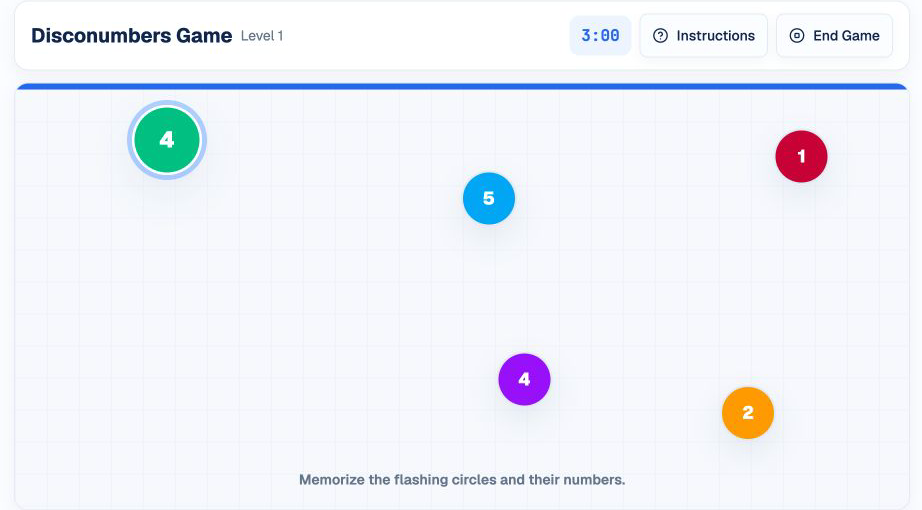
Disconumbers combines sequence memory with mental arithmetic. Numbered circles appear on screen and light up one at a time. After the sequence is shown, you select the circles in the same order and choose the correct sum from four answers.
This guide describes HireVueGames' independent Disconumbers practice. It can make the format more familiar, but it cannot reveal an employer's scoring model, reproduce proprietary content, or guarantee an assessment outcome.
What Is the HireVue Disconumbers Game?
Disconumbers is a timed cognitive format built around two linked decisions: remember the order in which circles light up, then add the numbers in that sequence. A correct response therefore depends on both sequence accuracy and a calm calculation.
The independent practice increases the challenge across six levels. Sequences grow, values become larger, circles can drift, and later levels may hide circle numbers while you replay the order.
How the Disconumbers Game Works
At the start of a level, numbered circles are placed across the stage. A subset lights up in sequence. Watch the order rather than clicking during this phase. When the sequence is complete, select the circles in that order.
After the replay, add the values from the sequence and choose the matching sum. A wrong circle, wrong order, wrong sum, or timeout ends the level attempt. A correct answer advances the adaptive practice to the next level.
A Reliable Disconumbers Routine
1. Group the sequence
Remember the selected circle locations and values as one short chain instead of trying to hold unrelated details. A quiet verbal rhythm can reduce order mistakes.
2. Confirm the phase before clicking
During the watch phase, observe. During the replay phase, select only the next circle. Waiting for the phase to change prevents a rushed first click.
3. Calculate after the order is secure
Do not start adding while the sequence is still being shown. First preserve the order, then perform the sum when the answer choices appear.
4. Reset after an error
The next round is a new sequence. Do not let a previous wrong circle or arithmetic slip change the pace of the next observation.
Common Disconumbers Mistakes
- Remembering only the values: the replay requires the circle order as well.
- Clicking during the watch phase: an early selection cannot reproduce the sequence.
- Adding the wrong circles: one order error changes the required sum.
- Guessing between close sums: recalculate the selected values before choosing.
- Treating practice feedback as an official score: the simulation does not reproduce an employer's scoring model.
How to Practice Disconumbers Effectively
Start by making the sequence reliable at the early levels. Then notice whether your errors come from location memory, value memory, order, or arithmetic. Short, focused sessions are more useful than trying to compensate for a missed sequence by clicking faster.
If your assessment invitation names a particular game or gives different instructions, use that invitation as the source of truth. Independent practice supports familiarity and pacing, but it cannot reproduce proprietary questions or predict hiring outcomes.
Practice the Disconumbers Format
Use Disconumbers practice to try the sequence-and-sum routine in a timed independent simulation.
For related memory and numerical formats, see the Numerosity guide, Digitspan guide, and Singularity guide.
Disclaimer: HireVueGames is an independent preparation platform and is not affiliated with, endorsed by, or operated by HireVue. This guide describes independent practice and does not reproduce HireVue's proprietary questions, behavioral model, scoring system, or employer evaluation process. It is not an official HireVue assessment, exact replica, or score prediction tool.
Related Guides
Numerosity Guide
Learn how to approach numerical reasoning and timing pressure.
Read GuideDigitspan Guide
Use memory routines and cleaner recall habits for sequence-style tasks.
Read GuideSingularity Guide
Build a calmer scan path for outlier detection and visual processing.
Read Guide