
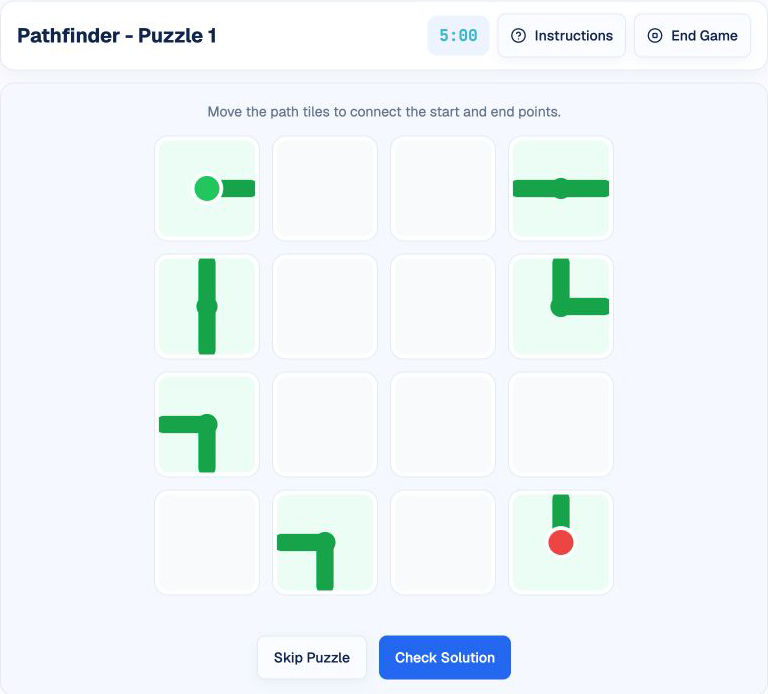
Pathfinder turns a route into a planning problem. A grid contains straight and turning path tiles, but their positions are scrambled. You must rearrange them until the connections form one continuous path from start to finish.
This guide describes the Pathfinder format. Repeated practice cannot guarantee an employer outcome, but it can make the sliding controls and connection rules familiar and help you replace random movement with a deliberate solving process.
What Is the HireVue Pathfinder Game?
Pathfinder is a timed spatial reasoning puzzle. A grid contains scrambled boxes with straight paths, corners, junctions, and empty positions. Marked start and finish points define the route you must build.
The goal is connectivity, not recreating a specific picture. Every adjoining path edge must connect correctly from start to finish. Practice layouts vary, while assessment versions may use different grids, movement controls, or progression.
What Skills Does Pathfinder Practice?
- Spatial reasoning: understanding how tile orientations connect across a grid.
- Problem-solving: turning an incomplete route into a valid path.
- Planning: identifying useful positions before moving tiles.
- Efficiency: limiting slides that do not advance the route.
- Attention: checking every neighboring connection before submission.
These are independent practice demands, not official employer scoring categories.
How the Pathfinder Game Works
The game is timed, typically with a five-minute limit. Move tiles horizontally or vertically into empty spaces until their edges form one continuous road from start to finish. Complexity increases with each successful puzzle, requiring quicker visualization and more efficient movement.
1. Inspect the Fixed Endpoints
Determine which direction the path must leave the start and enter the finish.
2. Identify Corners and Bottlenecks
Locate tiles with limited useful positions. Corners often define where the route must change direction.
3. Build a Continuous Chain
Work from one endpoint or from both ends toward the middle. Make each slide serve a planned connection.
4. Check Every Edge
Trace the completed route from start to finish before selecting Check Solution.
A Repeatable Pathfinder Strategy
Plan Before the First Slide
Spend a short moment identifying the likely route. Several purposeful slides are faster than many reversible experiments.
Work From Constrained Positions
Endpoint neighbors and corner locations offer fewer possibilities. Solve those before flexible middle positions.
Trace Connections, Not Tile Appearance
Follow open edges. A tile belongs where its top, right, bottom, and left connections align with adjacent tiles.
Preserve Completed Sections
Once a route segment connects correctly, avoid moving it into the empty space unless necessary.
Minimize Unnecessary Moves
Every slide consumes time and changes the position of the empty space. Plan how the empty position will reach the next required tile before moving it.
Common Pathfinder Mistakes
- Random sliding: changes the board without building a route.
- Ignoring the finish direction: creates a path that cannot enter the final tile.
- Checking only the visual line: misses incompatible edges between neighboring tiles.
- Breaking solved sections: adds avoidable recovery moves.
- Submitting without tracing: leaves one hidden gap in an otherwise convincing route.
A Practical Pathfinder Training Routine
Round 1: Prioritize Valid Paths
Plan first and trace every connection before checking.
Round 2: Reduce Unnecessary Slides
Notice which moves are later reversed. Replace them with a clearer route plan.
Round 3: Improve Time Allocation
Practice making purposeful moves under the five-minute limit without abandoning the route plan.
Understanding Your Pathfinder Practice Results
- Solved puzzles shows how many continuous paths you completed.
- Accuracy compares valid checks with broken-path checks.
- Response time shows how long each layout took before checking.
- Moves per puzzle can reveal whether route planning is reducing unnecessary sliding.
Use these metrics to compare your own route planning and execution. They do not represent an official HireVue or employer score.
Practice the Pathfinder Format
Use Pathfinder practice to practice planning, sliding, tracing, and checking a continuous route.
Related spatial formats include the Puzzle guide, Shapedance guide, and Singularity guide.
Disclaimer: HireVueGames is an independent preparation platform and is not affiliated with, endorsed by, or operated by HireVue. This guide describes independent practice and does not reproduce HireVue's proprietary questions, adaptive logic, scoring model, or employer evaluation process. It is not an official HireVue assessment, exact replica, or score prediction tool.
Related Guides
Puzzle Guide
Practice picture recall and systematic sliding-tile reconstruction.
Read GuideShapedance Guide
Practice visual matching, orientation, and pattern rules with less guesswork.
Read GuideSingularity Guide
Build a calmer scan path for outlier detection and visual processing.
Read Guide