
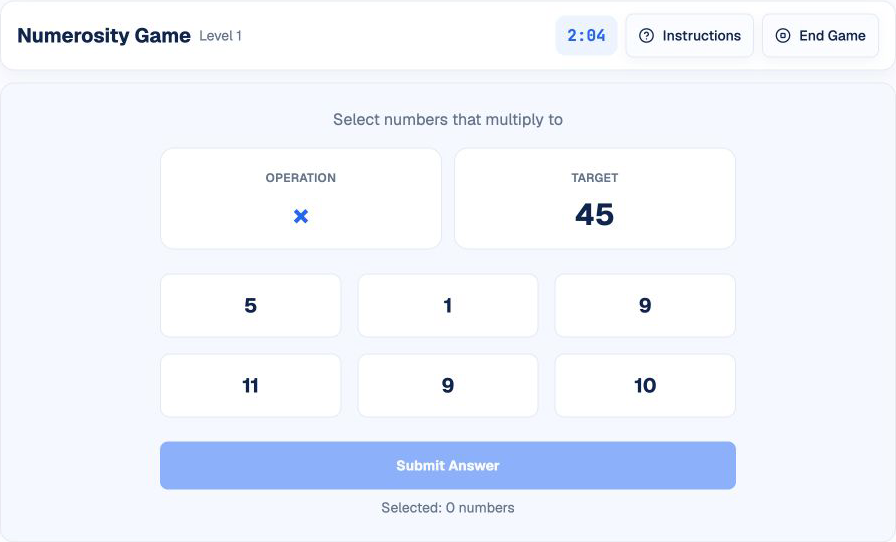
Numerosity can feel demanding because every question combines arithmetic, selection, and a running timer. The rule itself is straightforward: read the operation, find the numbers that produce the target, select the full combination, and submit it.
This guide describes the format used in HireVueGames' independent Numerosity practice. Familiarity cannot guarantee an employer result, but it can help you avoid learning the controls under pressure and give you a repeatable method for balancing calculation speed with accuracy.
What Is the HireVue Numerosity Game?
Numerosity is a timed cognitive task built around mental arithmetic. Each question presents three pieces of information:
- a target number;
- an operation: addition, subtraction, multiplication, or division;
- a set of available numbers.
Your objective is to select the numbers that produce the target using the displayed operation. The operation may change between questions, and the valid answer may contain two or more numbers.
Question complexity increases as you progress. Calculations become more demanding and more numbered hexagons can appear, requiring faster and more accurate mental arithmetic.
What Skills Does Numerosity Practice?
- Numerical reasoning: recognizing relationships between a target and the available numbers.
- Mental calculation: performing basic arithmetic without relying on a written calculation.
- Attention: checking the operation before applying a familiar strategy.
- Decision speed: selecting and submitting a valid combination while the timer continues.
- Performance under pressure: maintaining a reliable method across a sequence of questions.
These describe the demands of the practice task, not official employer scoring dimensions.
How the Numerosity Game Works
The timed game presents a target, an operation, and a set of numbered hexagons. Select two or more numbers, then submit the complete combination. Questions can use addition, subtraction, multiplication, or division, and complexity increases across the levels.
1. Read the Operation First
Do not begin calculating from the target alone. Confirm whether the question uses +, −, ×, or ÷, because the same numbers can suggest very different answers.
2. Work Backward From the Target
Use the target to narrow the search. For addition, ask what complement is missing. For multiplication, list likely factor pairs. For subtraction and division, look for a larger starting number that can produce the target.
3. Select the Complete Combination
Check whether the answer needs two or three numbers. Selecting only part of a valid addition combination or adding an extra number produces an incorrect result.
4. Submit and Reset
After the brief feedback, start the next question by checking its operation again. Do not carry the previous rule into the new calculation.
Strategies for Each Numerosity Operation
Addition: Find Complements
Start with the largest or most distinctive available number and subtract it mentally from the target. Search for the remaining value among the other options. If no pair works, test whether two smaller numbers combine to make the remainder.
Subtraction: Start With the Largest Candidate
The practice evaluates selected values from largest to smallest. Identify a plausible starting number above the target, then calculate the difference needed to reach the target. Avoid treating subtraction like an unordered addition problem.
Multiplication: Use Factor Pairs
Translate the target into familiar factors. For a target of 36, for example, look for 6 × 6, 4 × 9, or 3 × 12. A strong recall of basic multiplication tables reduces trial and error.
Division: Look for Dividend and Divisor
Find a number that is a clean multiple of the target, then look for the divisor that produces it. For a target of 5, 25 ÷ 5 and 10 ÷ 2 are possible structures. Confirm the selected values divide evenly before submitting.
Common Numerosity Mistakes
Reusing the Previous Operation
The operation changes between questions. Build a habit of naming it before looking for combinations.
Selecting the First Promising Pair
Some addition questions use three numbers. Calculate the selected set completely instead of assuming every answer is a pair.
Guessing Through Difficult Questions
Fast random selections increase attempts but usually reduce useful accuracy. Use a short backward calculation before committing.
Ignoring Selection Order in Non-Commutative Operations
Subtraction and division do not behave like addition and multiplication. Begin with the largest selected value and verify the remaining operation carefully.
Letting One Error Disrupt the Next Question
Feedback is brief. Reset immediately: operation, target, options, combination.
A Practical Numerosity Training Routine
Round 1: Prioritize Correct Setup
Name the operation and explain the combination to yourself before submitting. The goal is to remove rule errors.
Round 2: Focus on Weak Operations
Review results by operation. Practice complements if addition is slow, factor pairs if multiplication is weak, or clean multiples if division causes hesitation.
Round 3: Improve Pace Carefully
Keep the same calculation method while shortening unnecessary rechecking. If accuracy drops sharply, return to the slower routine rather than compensating with guesses.
Understanding Your Numerosity Practice Results
Use independent practice results to compare your own rounds:
- Accuracy shows how often your selected combination reached the target.
- Questions submitted shows how many decisions you completed in three minutes.
- Average response time shows how quickly you moved from seeing a question to submitting it.
- Operation breakdown can reveal whether one arithmetic type causes most errors or delays.
More attempts are useful only when accuracy remains stable. High accuracy with very few attempts suggests excessive rechecking; many attempts with falling accuracy suggests rushed calculation. Neither metric alone predicts an employer result.
Practice the Numerosity Format
Use Numerosity practice to apply the operation-target-combination routine in a timed round. Repeated practice can make the interaction more familiar and help you identify which operation needs the most work.
Related formats include the Digitspan guide, Flashback guide, and Pathfinder guide.
Disclaimer: HireVueGames is an independent preparation platform and is not affiliated with, endorsed by, or operated by HireVue. This guide describes independent practice and does not reproduce HireVue's proprietary questions, adaptive logic, scoring model, or employer evaluation process. It is not an official HireVue assessment, exact replica, or score prediction tool.
Related Guides
Digitspan Guide
Use memory routines and cleaner recall habits for sequence-style tasks.
Read GuideFlashback Guide
Improve visual memory, comparison accuracy, and response control.
Read GuidePathfinder Guide
Plan connected routes and move path tiles efficiently.
Read Guide